Make Sustainability Tangible
Translate sustainability performance of products into concrete outcomes such as reduced emissions, resource savings or improved circularity.

Many products and services help customers reduce emissions, save resources, improve circularity and achieve sustainability goals. Yet the focus often remains on negative impacts while positive contributions remain invisible.
A sustainability handprint describes the beneficial outcomes a product or service can enable downstream, from customer processes and manufacturing operations to consumer use. It provides a structured way to identify, assess and communicate this value, turning sustainability contributions into tangible business benefits.
From Footprint to Handprint
While footprints help organizations understand and reduce their environmental and social impacts, handprints reveal the positive sustainability outcomes products and services can enable for customers and value chains.
Together, they provide a complementary picture of sustainability performance.
Footprint: What negative impact does a product create?
Handprint: Which sustainability benefits can a product enable?
Turn Sustainability into Business Value
Translate sustainability performance of products into concrete outcomes such as reduced emissions, resource savings or improved circularity.
Replace generic claims with measurable, customer-relevant sustainability benefits that stand out.
Move beyond product features and pricing discussions by engaging customers on sustainability challenges, opportunities and long-term value creation.
Connect sustainability performance with commercial opportunities, customer needs and evolving market expectations.
Demonstrate how sustainability contributes to your company’s business success by linking environmental and social value creation to commercial strategies.
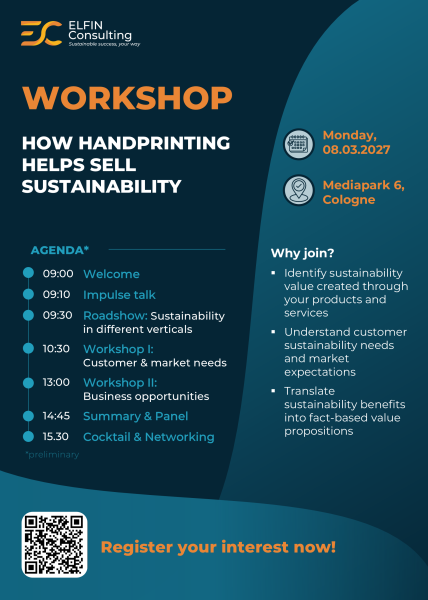
How Handprinting helps sell Sustainability
Together with industry experts and peers, participants will learn how to identify sustainability opportunities, understand customer needs and translate sustainability benefits into compelling value propositions
What to expect
A handprint only creates value when it becomes visible and actionable.
Our structured 5-step approach helps organizations identify sustainability outcomes, quantify their value and translate them into compelling customer benefits:
Identify relevant sustainability challenges, priorities and expectations across customer segments, markets and value chains.
Key question: What pressures and objectives shape this customers sustainability approach?
Determine which products, services or technologies can contribute to the identified customer needs and objectives.
Key question: What sustainability benefits can your product create at the customer?
Translate enabled sustainability outcomes into clear and differentiated value propositions.
Key question: Why should the customer care?
Substantiate value propositions with credible data and measurable outcomes – in line with relevant regulations.
Key question: How can the value be demonstrated credibly?
Communicate sustainability value effectively through sales enablement, targeted customer conversations, and market positioning.
Key question: How does the sustainability value reach the market?
Smart Monitoring Chips for Industrial Equipment

Technology: Semiconductors enable real-time monitoring of machines and production equipment, helping manufacturers track performance, energy consumption and maintenance needs.
Handprint: Smart monitoring chips enable manufacturers to identify inefficiencies, reduce energy consumption and optimize resource use throughout production processes.
Short-stature Corn Enables Resource Efficiency

Technology: Short-stature corn allows late-season field access with standard equipment, enabling fertilizer to be applied precisely when crops need it most.
Handprint: Short-stature corn enables farmers to improve nitrogen-use efficiency, reduce fertilizer losses and optimize resource use while maintaining productivity.
Efficient Running Cycles Enable Reduced Water Use

Technology: A washing machine uses advanced sensors and optimized wash programs to reduce water and energy consumption per cycle.
Handprint: Smart washing enables lower resource consumption for consumers during everyday use resulting in reduced energy use and utility costs.

Manager

Senior Consultant

Senior Consultant
Let’s explore how sustainability handprints can help your organization strengthen customer value propositions, differentiate solutions and support sustainable growth.
ELFIN Consulting GmbH
Im Mediapark 6b
50670 Köln
Germany
Fon: +49 (0) 221 6705 6660
Fax: +49 (0) 221 6705 6661
